Salary vs. Dividends: How to Pay Yourself as a Business Owner?
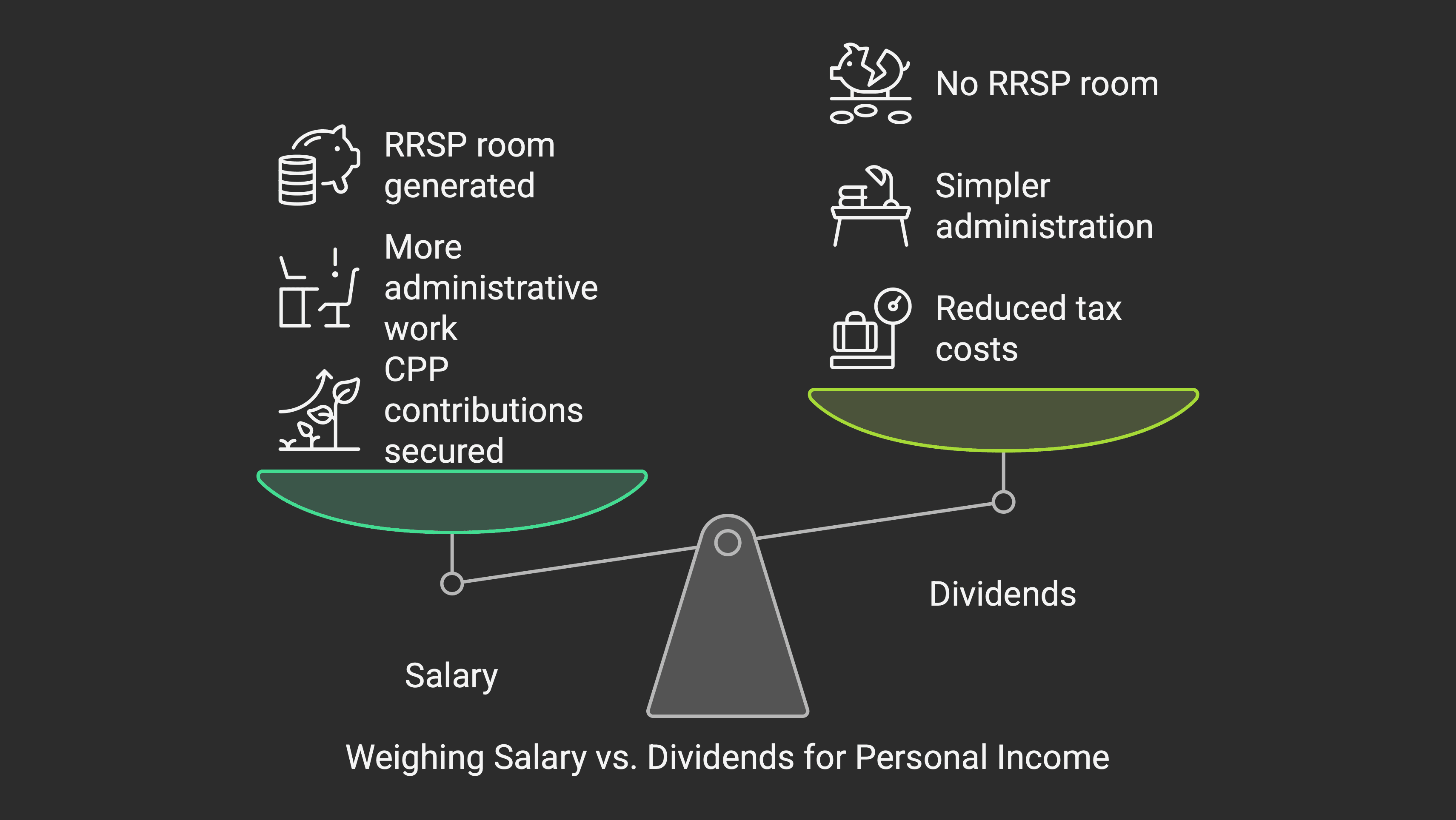
As discussed in the previous, Should You Incorporate Your Business blog post, incorporating add flexibility when it comes to your compensation. As a incorporated business owner, deciding how to pay yourself is a critical financial decision that affects your taxes, cash flow, and long-term financial planning. The two primary ways to compensate yourself are through salary or dividends—each with its own tax implications and benefits. Understanding the differences will help you optimize your compensation strategy while staying compliant with Canadian tax laws.
Key takeaways
Salary creates RRSP contribution room and CPP entitlement, deducts against corporate income, and produces a T4 — making it the right choice when you want personal credits, mortgage qualification, or retirement contribution room.
Dividends skip CPP entirely and avoid payroll source deductions, but produce no RRSP room and rely on the dividend tax credit under ITA section 121 for integration with corporate tax already paid.
Integration means the combined personal and corporate tax on $1 of profit is roughly the same whether paid as salary or non-eligible dividends, so the choice usually comes down to non-tax factors.
A salary-dividend mix is the most common owner-manager strategy: enough salary to maximize CPP and RRSP, with the balance taken as dividends to skip employer CPP and EI.
What Are Salary and Dividends?
Salary
A salary is a regular, earned income paid to you as an employee of your corporation. Just like any other employee, you receive a paycheck, from which income tax, CPP (Canada Pension Plan) contributions, and other deductions are withheld.
Dividends
Dividends are payments from after-tax corporate profits to shareholders. Unlike salary, dividends do not require CPP contributions or payroll deductions, but they are taxed differently when received personally.
Pros and Cons of Salary vs. Dividends
✅ Benefits of Paying Yourself a Salary
• Consistent income for personal financial planning.
• Reduces corporate taxable income, lowering corporate tax liability.
• Builds CPP contributions, helping secure retirement benefits.
• Generates RRSP contribution room for tax-deferred savings.
• May be required if applying for mortgages or loans (lenders prefer T4 income).
❌ Drawbacks of Salary
• Requires payroll remittances, which adds administrative work.
• Higher personal income tax rates than dividends in some cases.
• Both employer and employee must pay CPP contributions.
✅ Benefits of Paying Yourself Dividends
• Lower personal tax rates due to the dividend tax credit.
• No CPP contributions, reducing overall tax costs.
• Simpler administration—no payroll setup or remittances.
• More flexibility in timing payments based on business profits.
❌ Drawbacks of Dividends
• No CPP contributions, which may impact your retirement savings.
• Does not generate RRSP contribution room.
• Income is less predictable, making personal financial planning harder.
• Not considered earned income, which can affect government benefits like child tax credits.
Salary, Dividends, or a Mix?
Many business owners choose a combination of salary and dividends to balance tax efficiency and retirement planning. A common strategy is to:
1. Pay a base salary to maximize RRSP contribution room and CPP benefits.
2. Supplement income with dividends to take advantage of lower tax rates.
The ideal mix depends on:
• Your personal financial needs.
• The business’s profitability.
• Tax planning opportunities.
Consult Us for Tax Planning and Compensation Strategies
Choosing how to pay yourself is not a one-size-fits-all decision. Factors like corporate profits, personal tax brackets, and future retirement plans all play a role. Working with an accountant ensures you optimize your compensation strategy while staying compliant with Canadian tax laws.
At ModernAxis, we specialize in tax planning for business owners, helping you structure your compensation for maximum financial benefits. Contact us today to develop a strategy that works for you!
Final Thoughts
Both salary and dividends offer unique advantages, and the best approach depends on your financial situation. By understanding the tax implications and planning accordingly, you can reduce taxes, secure retirement benefits, and optimize cash flow for both you and your business.
Would you like a personalized salary vs. dividend analysis for your business? Book a consultation with ModernAxis today!
Disclaimer: This blog post is for informational purposes only and does not constitute professional tax advice.
Frequently asked questions
Which is better, salary or dividends, for a Canadian business owner?
There is no universal answer. Salary is better if you want RRSP room, CPP benefits, child care expense claims, or a clean T4 for mortgage qualification. Dividends are better if you want to skip CPP (both employer and employee portions), avoid payroll administration, or pay out accumulated retained earnings. Most owner-managers use a mix, which is what Modern Axis CPA typically recommends after running both scenarios in personal tax software.
Do I have to pay CPP on dividends?
No. Dividends are not pensionable earnings under the CPP Act, so they are exempt from both employee and employer Canada Pension Plan contributions. This is one of the main appeals of dividends — they save the roughly 11.9 percent combined CPP rate on income up to the YMPE. The trade-off is no CPP credit accrues for retirement, and any CPP shortfall must be replaced through RRSP or TFSA savings.
Do dividends count for RRSP contribution room?
No. RRSP contribution room is calculated as 18 percent of earned income, and dividends are not earned income under ITA section 146(1). Only salary, T4 employment income, self-employment income, and rental income generate RRSP room. Owner-managers who rely solely on dividends will see their RRSP contribution room stop accumulating, which is often a deciding factor for retirement-focused planning.
What is the difference between eligible and non-eligible dividends?
Eligible dividends are paid out of corporate income that was taxed at the general corporate rate (above the SBD limit) and receive a higher gross-up and dividend tax credit. Non-eligible dividends are paid from income taxed at the Small Business Deduction rate and receive a smaller gross-up and credit. The eligible category produces a more favourable personal tax outcome, but only the General Rate Income Pool (GRIP) of the corporation can fund eligible dividends under ITA section 89(1).
Can I pay myself with a mix of salary and dividends?
Yes, and this is the most common owner-manager strategy. A typical approach is enough salary to maximize CPP contributions (around $74,600 of YMPE for 2026), claim full RRSP room (about $187,833 of salary maxes the 2026 contribution limit), and meet basic personal credits, then take the rest as dividends. The exact mix depends on age, retirement plan, mortgage needs, and whether the corporation has GRIP for eligible dividends.
Do I need to issue myself a T4 for salary?
Yes. Salary paid to an owner-manager goes through the corporation's payroll, meaning CRA source deductions (income tax, CPP, sometimes EI), monthly or quarterly payroll remittances, a T4 slip issued by the end of February, and a T4 summary filed with CRA. Dividends, by contrast, are reported on a T5 issued by the corporation and require no payroll administration during the year.
Alex Ataman, CPA
Founder
Modern Axis CPA