What Are Tax Instalments in Canada?
If you earn income without regular payroll deductions—or run a profitable business—there’s a strong chance the Canada Revenue Agency (CRA) expects you to pay tax instalments. This often surprises people: “Why am I paying tax before I’ve even filed my return?”
Key takeaways
CRA requires tax instalments when net tax owing exceeded $3,000 ($1,800 in Quebec) in either of the prior two years for individuals, or in either of the prior two years for corporations.
New corporations are exempt from instalments in their first fiscal year even if tax owing exceeds $3,000 — the obligation starts in year two.
Personal instalments are due quarterly (March 15, June 15, September 15, December 15); corporate instalments are monthly by default, with quarterly available only to CCPCs claiming the small business deduction.
CRA charges 7% annually (Q1 2026 rate, reviewed quarterly) compounded daily on late or insufficient instalments — plus a separate penalty if instalment interest exceeds $1,000.
Short answer: CRA doesn’t like waiting when there’s a track record of tax owing.
This guide explains exactly how tax instalments work in Canada, who must pay them, how amounts are calculated, due dates, penalties, and practical strategies to avoid interest—without wrecking your cash flow.
What Are Tax Instalments?
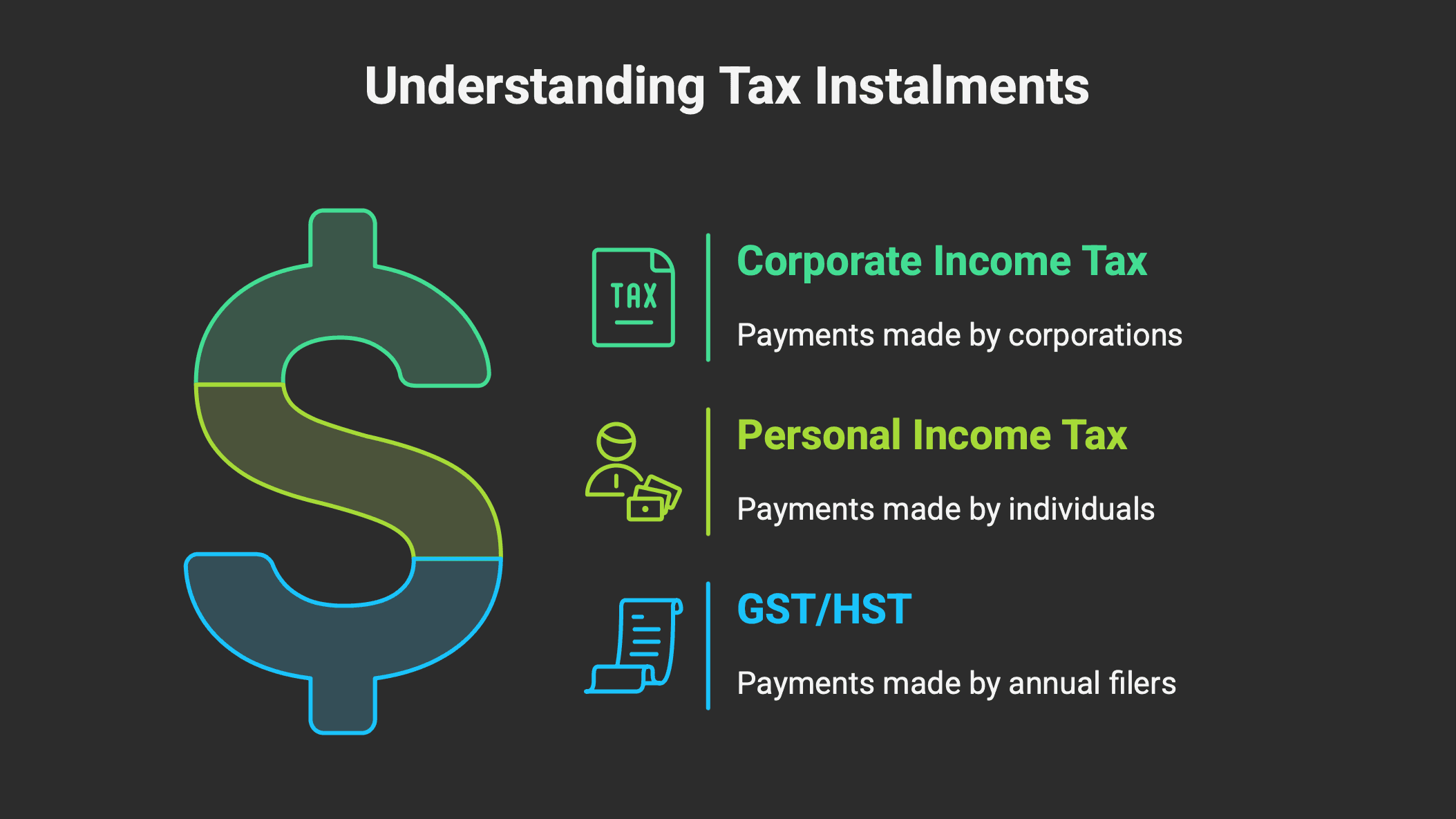
Tax instalments are advance payments toward income tax or GST/HST you’re expected to owe for the year. Instead of paying a large lump sum at filing time, CRA spreads payments throughout the year based on your history.
Instalments apply to:
Corporate income tax
Personal income tax
GST/HST (annual filers only)
They are not optional once CRA determines you qualify.
Corporate Income Tax Instalments
Who Needs to Pay Corporate Instalments?
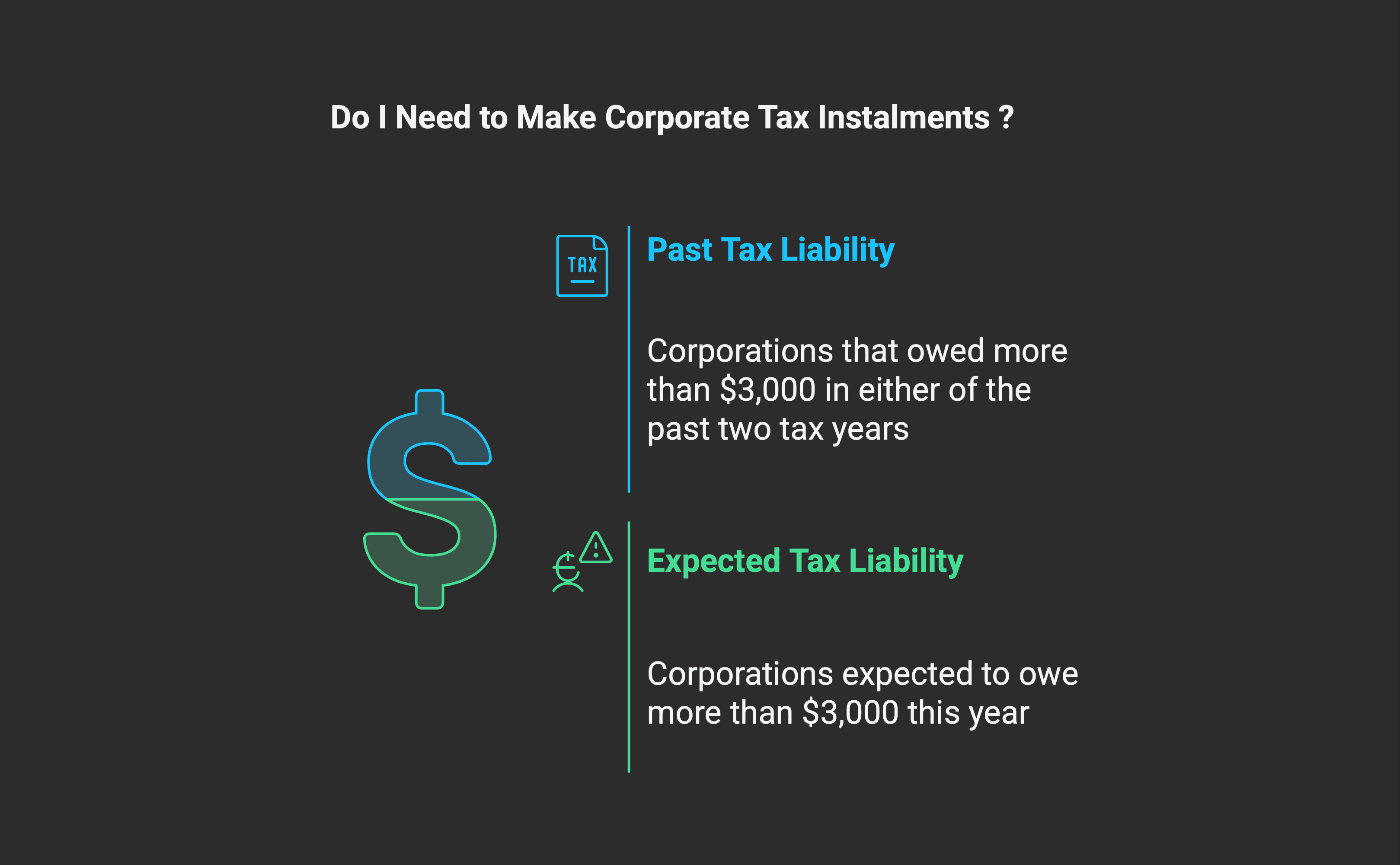
Your corporation must make instalments if either condition applies:
It owed more than $3,000 in tax in either of the previous two tax years, or
It expects to owe more than $3,000 in the current year
First-year corporation exception: New corporations do not pay instalments in their first fiscal year, even if tax owing exceeds $3,000.
Example:
Instalment Maker Inc. incorporated in 2024 and owed $4,500 for its first year.
→ No instalments in 2024
→ Instalments required in 2025
Corporate Instalment Due Dates
Monthly (default)
First payment: one month after fiscal year start
Then monthly thereafter
Quarterly (only if ALL conditions are met)
You may qualify for quarterly instalments if:
You are a Canadian-Controlled Private Corporation (CCPC)
You claimed the Small Business Deduction
Taxable income ≤ $500,000
Taxable capital ≤ $10 million
Strong compliance history with CRA
Quarterly due dates (calendar year-end):
March 31
June 30
September 30
December 31
Miss any condition and CRA pushes you back to monthly payments.
How Much Should a Corporation Pay?
Modern Axis CPA will calculate corporate instalments using one of the following approaches, depending on your situation:
Prior-year method
Instalments are based on the prior year’s tax owing, divided by 12 (monthly) or by 4 (quarterly, if eligible). This approach is commonly used when income is stable year over year.Current-year estimate method
Instalments are based on an estimate of the current year’s taxable income. This approach is appropriate when income has materially increased or decreased, but it requires careful forecasting to avoid interest.
The instalment frequency (monthly or quarterly) is determined based on CRA eligibility rules and your corporation’s profile. Proper calculation and monitoring throughout the year is critical to avoid underpayment.
Personal Income Tax Instalments
Who Needs to Pay Personal Instalments?
You may be required to make instalments if net tax owing exceeded $3,000 ($1,800 in Quebec) in either of the previous two years.
Common situations include:
Self-employed individuals
Sole proprietors
Rental property owners
Investors with untaxed income
Example:
2023 tax owing: $2,000 → no instalments
2024 tax owing: $4,500 → instalments required for 2025
Personal Instalment Due Dates
Personal instalments are due quarterly:
March 15
June 15
September 15
December 15
If the date falls on a weekend or holiday, payment is due the next business day.
How Much Do Individuals Pay?
The same three methods apply:
CRA reminder amounts (recommended)
Prior-year tax ÷ 4
Current-year estimate ÷ 4
Underestimating instalments commonly results in interest.
GST/HST Instalments (Annual Filers Only)
Who Must Pay GST/HST Instalments?
GST/HST instalments apply only if:
You file GST/HST annually, and
Net tax owing was $3,000 or more in the previous fiscal year
Monthly and quarterly filers do not make instalments.
GST/HST Instalment Due Dates (Calendar Year)
April 30
July 31
October 31
January 31
How Much to Pay?
Prior year’s net GST/HST ÷ 4, or
CRA’s suggested amounts
Estimating lower payments is allowed, but interest applies if underpaid.
How to Make Instalment Payments
CRA strongly encourages electronic payments, and Modern Axis CPA recommends setting up payments directly through CRA wherever possible for accuracy, automation, and audit trail.
1. CRA Online Portals (Recommended)
You can make and automate instalment payments through CRA’s online services:
My Business Account – for corporate income tax and GST/HST
My Account – for personal income tax
Within these portals, you can:
View instalment balances and due dates
Set up pre-authorized debit (PAD) for automatic withdrawals
Schedule future payments in advance
Reduce the risk of missed or late payments
Setting up PAD through CRA ensures payments are applied correctly and on time. This is the preferred method, especially for ongoing instalment obligations.
2. Online Banking
You can also pay instalments through online banking by adding CRA as a payee and using the correct reference number:
Business Number (BN) – for corporate tax or GST/HST
Social Insurance Number (SIN) – for personal tax
Online banking works well for manual payments but requires discipline to avoid missed deadlines.
What Happens If You Don’t Pay Instalments?
CRA charges daily-compounded interest on late or insufficient instalment payments.
As of Q1 2026, CRA’s prescribed interest rate for instalment arrears is 7% annually, compounded daily. This rate is reviewed and updated quarterly, meaning it can increase or decrease depending on economic conditions.
In addition to interest, instalment penalties may apply if:
CRA’s required instalment amounts were not paid, and
The total interest exceeds $1,000
Penalties and interest can apply even if the full tax balance is ultimately paid by the filing deadline.
Common Tax Instalment Mistakes
Assuming instalments are optional
Underestimating current-year income
Missing a single payment
Confusing GST/HST instalments with income tax
Ignoring CRA notices
Need Help Managing Tax Instalments?
Instalments become complex when income fluctuates or multiple taxes are involved.
Modern Axis CPA helps individuals and businesses across Canada forecast instalments, manage cash flow, and avoid CRA interest and penalties.
Let’s talk about how we can help you stay compliant and stress-free.
Frequently asked questions
Who has to pay tax instalments in Canada?
Individuals must pay personal tax instalments when net tax owing exceeded $3,000 ($1,800 in Quebec) in either of the previous two tax years. Corporations must pay if they owed more than $3,000 in either of the previous two years or expect to owe more than $3,000 in the current year. GST/HST instalments apply only to annual filers whose net tax was $3,000 or more in the previous fiscal year. Monthly and quarterly GST/HST filers are exempt.
What are the personal tax instalment due dates in Canada?
Personal tax instalments are due quarterly: March 15, June 15, September 15, and December 15. If a due date falls on a weekend or statutory holiday, payment is due the next business day. CRA sends instalment reminders in February and August showing the suggested amounts based on prior-year tax owing. Paying the CRA reminder amount on time is the safest method — it provides a complete defence against instalment interest and penalties.
Can I skip a tax instalment if I won't owe as much this year?
You can use the current-year estimate method and pay less than the CRA reminder amount, but if you underestimate, daily-compounding interest at the prescribed rate (7% as of Q1 2026) applies to the shortfall. CRA reviews the rate quarterly. There are three accepted methods — CRA reminder amount, prior-year method, and current-year estimate — and you can pick whichever produces the lowest required instalment, as long as you actually meet that minimum.
When does a corporation qualify for quarterly instead of monthly tax instalments?
A corporation may pay quarterly instalments only if it meets all of these: it's a Canadian-Controlled Private Corporation (CCPC), it claimed the small business deduction in the current or prior year, taxable income is $500,000 or less, taxable capital is $10 million or less, and it has a clean CRA compliance history. Miss any condition and CRA moves the corporation back to monthly instalments. Quarterly due dates for a calendar year-end are March 31, June 30, September 30, and December 31.
What's the penalty for missing a tax instalment?
CRA charges daily-compounding interest at the prescribed instalment rate — currently 7% annually for Q1 2026, reviewed and updated quarterly. On top of that, an instalment penalty applies if your total instalment interest for the year exceeds $1,000. The penalty equals 50% of the amount by which instalment interest exceeds the greater of $1,000 and 25% of what would have been charged with no instalments paid. Both apply even if you pay the full balance at filing.
How do I pay CRA tax instalments?
The preferred method is pre-authorized debit through My Business Account (for corporations and GST/HST) or My Account (for personal tax). PAD lets CRA withdraw the right amount on the due date automatically. Alternatives: online banking with CRA added as a payee using the Business Number or Social Insurance Number as reference; in-person at a financial institution with a remittance voucher; or wire transfer for non-residents. CRA no longer accepts cheques mailed for instalments without a voucher.
Alex Ataman, CPA
Founder
Modern Axis CPA