Section 55(2): When Inter-Corp Dividends Become Capital Gains

Inter-corporate dividends in Canada are usually tax-free under section 112 of the Income Tax Act — a Canadian corporation receiving a dividend from another Canadian corporation generally gets a 100% deduction, so no corporate tax is paid on the dividend flow. This is the structural foundation that makes holdco structures, family business reorganizations, and even basic group-level tax planning possible.
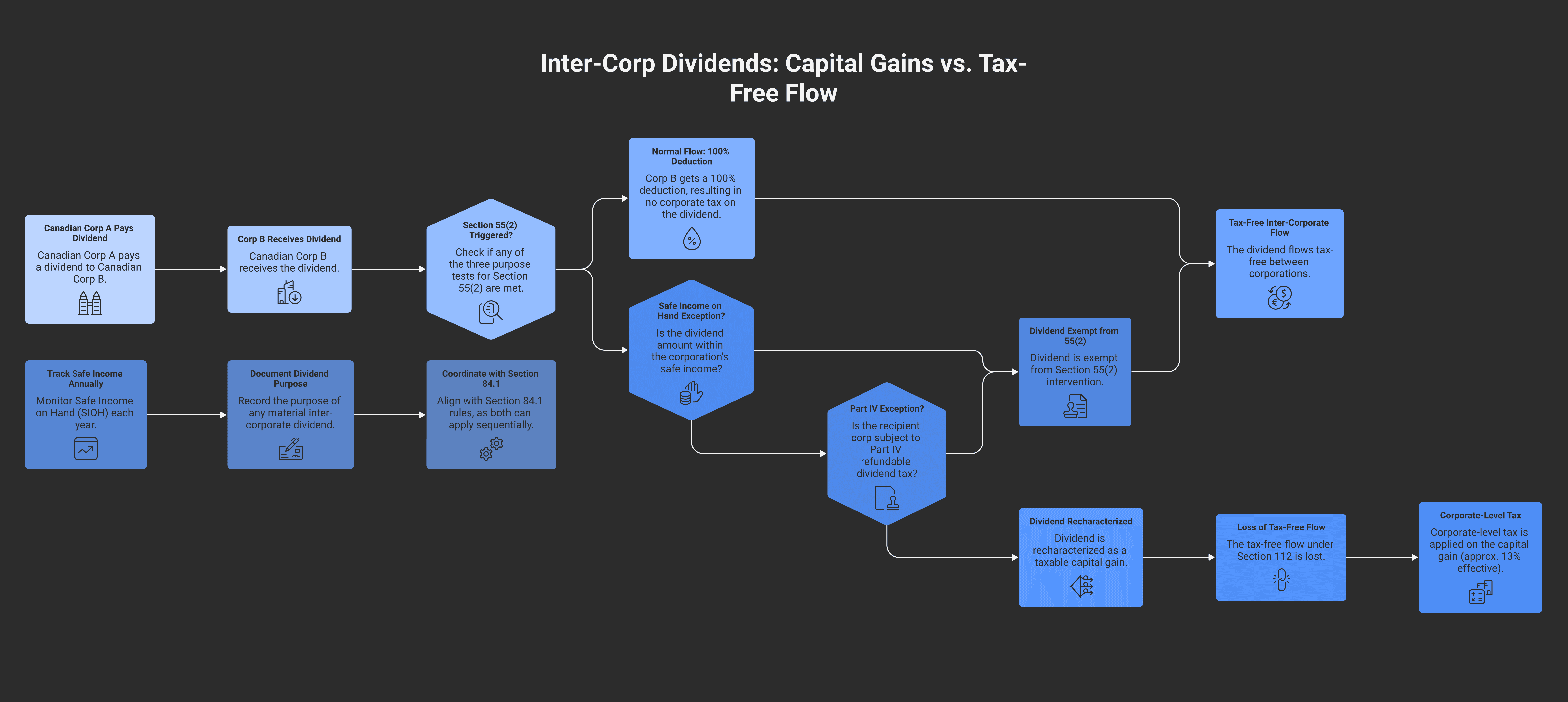
But section 55(2) of the Income Tax Act is the anti-avoidance rule that breaks the normal tax-free flow when the dividend's purpose involves stripping value or manipulating cost base. Section 55(2) recharacterises a tax-free dividend as a taxable capital gain — and the 2015 amendments massively expanded the rule's scope, catching many transactions that practitioners previously considered safe.
This guide walks through what section 55(2) does, the dramatically expanded post-2015 purpose tests, the safe income on hand exception, the Part IV tax exception, and how to structure inter-corporate dividend flows that don't trip the rule.
Key takeaways
Section 55(2) of the Income Tax Act recharacterises an otherwise tax-free inter-corporate dividend as a taxable capital gain when the dividend's purpose meets one of three tests: reducing a capital gain, increasing the recipient's cost base, or being part of a series leading to a redemption.
2015 amendments expanded the purpose test dramatically — pre-2015, section 55(2) was relatively easy to navigate. Post-2015, almost any inter-corporate dividend in a complex structure needs purpose-test analysis.
The safe income on hand exception under subsection 55(5) is the most important practical relief. A dividend paid out of a corporation's safe income (essentially after-tax retained earnings accumulated since acquisition) escapes section 55(2). Safe income tracking is critical for holdco-operating-co structures.
The Part IV tax exception in the opening words of subsection 55(2) — where the recipient corporation is subject to Part IV refundable dividend tax that is not refunded — provides an alternative exit from section 55(2). But the exception itself has been narrowed since 2015.
For routine inter-corporate dividends between an operating company and a wholly-owned holding company, careful safe-income determination and the separate-dividend designation under paragraph 55(5)(f) can preserve tax-free flow. Where safe income is insufficient, structures may need to be redesigned or specific elections used.
Why inter-corporate dividends are usually tax-free
Section 112(1) of the Income Tax Act provides a 100% deduction to a Canadian corporation receiving a dividend from another Canadian corporation. The result: the dividend flows from one corporation to another with no corporate tax owed.
This is the structural foundation of:
Holdco structures — Operating Co earns income, pays dividend to Holdco, Holdco invests retained earnings
Family corporate reorganizations — Existing CCPC's surplus is moved to a new structure via inter-corp dividends
Group tax planning — Multiple corporations under common control share dividend flow without corporate-level layers
Estate planning — Holdco accumulates corporate value pre-sale
Without section 112, every inter-corporate dividend would be re-taxed at the receiving corporation's level — making complex Canadian corporate structures economically infeasible. Section 112 is one of the most important architectural provisions in the Canadian tax system.
What section 55(2) actually does
Section 55(2) intervenes when a tax-free dividend's purpose falls into one of three categories. If section 55(2) applies:
The dividend is recharacterised as a taxable capital gain to the recipient corporation
The capital gain is computed as: dividend amount × the safe-income-excess proportion (the part of the dividend not protected by safe income)
The recipient corporation pays corporate-level tax on the gain (50% inclusion × general corporate rate ~26% combined = effectively ~13% tax on the dividend amount)
The recipient corporation can sometimes recover this corporate tax via dividends paid out to its shareholders (via RDTOH refund mechanic), but the immediate corporate-level tax cost is real.
The three purpose tests (post-2015)
Subsection 55(2.1) of the Income Tax Act sets out three purpose tests. Section 55(2) applies if any one of these is met:
Test 1: Reduce a capital gain
The dividend results in a reduction of the capital gain that would otherwise have been realized on a disposition of the shares of the payer corporation. Classic example: a corporation pays a large dividend before being sold, reducing the FMV of its shares. The buyer pays less for the shares (lower capital gain to the seller).
Pre-2015 analysis required showing this was a primary purpose. Post-2015, even where the dividend is part of normal business operations, the test can be tripped if there is any reduction in a potential capital gain — making the test much broader in practical effect.
Test 2: Increase the recipient's cost base
The dividend results in an increase of the recipient corporation's adjusted cost base (ACB) in property other than the shares of the payer. Classic example: a holdco receives a dividend and uses it to acquire new property (or pay down debt secured by property), increasing the cost base of that property.
This test catches transactions where dividends are used to "build up" cost base in other holdings — a common but not always intentional structuring.
Test 3: Series leading to share redemption
The dividend is part of a series of transactions or events that includes a disposition or redemption of the payer corporation's shares. This catches structures where a dividend is followed by a redemption — converting the value into something other than a dividend at the corporation level.
The safe income on hand exception (subsection 55(5))
The most important practical relief from section 55(2) is the safe income on hand exception under subsection 55(5). The exception:
A dividend is exempt from section 55(2) to the extent it is paid out of the corporation's "safe income on hand" (SIOH)
SIOH is broadly the corporation's after-tax retained earnings accumulated since the shares were last acquired by the recipient (the "holding period")
Calculating safe income is the most technical aspect of section 55(2) compliance:
Start with the corporation's net income (or taxable income) for tax purposes from the date the shares were acquired by the recipient
Adjust for various tax-vs-book differences (depreciation, capital cost allowance, etc.)
Subtract non-deductible expenses
Subtract dividends already paid (which depleted earlier SIOH)
Result is the safe income amount available to fund tax-free inter-corp dividends
A dividend up to the SIOH is tax-free under the section 55(5) exception. A dividend in excess of SIOH is subject to section 55(2) — recharacterised as a capital gain to the extent of the excess.
SIOH tracking is required. Most Canadian corporations don't track SIOH in real time — it's typically calculated only when a section 55-relevant transaction is contemplated. For owner-managed groups planning a holdco dividend, the SIOH calculation is often the first step.
The Part IV tax exception (opening words of subsection 55(2))
A second exception, in the opening words of subsection 55(2), applies when the recipient corporation is subject to Part IV refundable dividend tax on the dividend that is not refunded, AND the Part IV tax is refunded to the corporation when the corporation pays a dividend to its shareholders.
The logic: if the dividend flows through and triggers Part IV tax that's later refunded, the system has tracked the dividend with refundable tax. Section 55(2) doesn't need to apply.
Limitations:
The Part IV tax must not be refunded as a result of a dividend paid to a corporation that itself was subject to section 55(2)
The exception was narrowed in 2015 amendments — making it less broadly applicable
The Part IV exception is mostly relevant for structures where investment income flows up through multiple corporate layers — particularly common in holdco structures.

Common scenarios where section 55(2) bites
Scenario 1: Operating Co pays large dividend to Holdco before sale. Classic gain-reduction case. Section 55(2) likely applies unless SIOH covers the dividend in full. If Operating Co was built up over many years with substantial retained earnings, SIOH may well cover the dividend — but the calculation is required.
Scenario 2: Holdco receives operating company dividend and uses it for real estate purchase. Cost-base-increase test triggers. Section 55(2) likely applies. The fix: use safe income to fund the dividend, or restructure so the real estate is acquired by Operating Co directly.
Scenario 3: Owner manager pays large dividend from CCPC to holdco, then redeems Holdco shares. Series-leading-to-redemption test triggers. Section 55(2) applies (the series test catches even multi-step transactions where the dividend is part of a coordinated plan).
Scenario 4: Routine annual dividend from operating co to holdco, well within safe income. Section 55(2) doesn't apply because no purpose test is triggered AND safe income covers the dividend. This is the most common situation.
Scenario 5: Dividend funding a hostile-takeover defense. Most commercial defensive dividends meet one of the purpose tests. Section 55(2) potentially applies. Defensive dividends are typically structured with SIOH considerations and dedicated analysis.
Practical compliance for owner-manager groups
For most owner-managed CCPC groups (operating co + holdco), section 55(2) compliance involves:
Annual SIOH tracking. Maintain a running SIOH calculation for the operating company. This becomes critical when a dividend to the holdco is contemplated. Without SIOH numbers, the operating co cannot determine whether a contemplated dividend is safe.
Pre-dividend purpose test analysis. Before paying a material inter-corporate dividend, document the purpose. If the dividend is routine annual extraction of profits (i.e., not part of a sale, not building up cost base elsewhere), the purpose tests may not bite — but the analysis should be documented.
Section 55(5) election in complex flows. Where multiple corporations are involved, specific designations on T2 returns (e.g., the section 55(5) safe income designation) can clarify which portion of a dividend is funded by safe income.
Avoid the "series" trap. Section 55(2)'s third test (series leading to redemption) catches transactions that look benign in isolation but are part of a coordinated multi-step plan. CRA looks at the substance of the series, not the individual steps.
Coordinate with section 84.1 analysis — many transactions trigger both rules simultaneously. The interaction is complex; both rules can apply in sequence.
For Modern Axis client engagements on owner-manager groups, annual SIOH tracking and purpose-test analysis for any material inter-corporate dividend is the standard practice. The cost of getting it wrong is the corporate-level tax differential plus penalty interest — frequently $50K-$500K depending on the transaction size.
Frequently asked questions
What is section 55(2) of the Income Tax Act?
Section 55(2) is an anti-avoidance rule that recharacterises an otherwise tax-free inter-corporate dividend as a taxable capital gain when the dividend's purpose meets one of three tests: reducing a capital gain, increasing the recipient's cost base, or being part of a series leading to a share redemption. The rule was significantly expanded by 2015 amendments — pre-2015, section 55(2) was relatively easy to navigate; post-2015, almost any material inter-corporate dividend in a complex structure needs purpose-test analysis.
Why are inter-corporate dividends tax-free in Canada?
Inter-corporate dividends are tax-free under section 112 of the Income Tax Act — a Canadian corporation receiving a dividend from another Canadian corporation gets a 100% deduction. This structural rule prevents multiple layers of corporate tax on the same underlying income and makes Canadian corporate structures (holdco-operating-co, group reorganizations) economically viable. Section 55(2) is the targeted anti-avoidance backstop that catches abusive transactions.
What are the three purpose tests under section 55(2.1)?
Section 55(2.1) sets out three purpose tests for inter-corporate dividends: (1) reducing a capital gain that would otherwise have been realized on a share disposition, (2) increasing the recipient corporation's adjusted cost base in property other than the payer's shares, and (3) being part of a series of transactions that includes a disposition or redemption of the payer's shares. If any one test is met, section 55(2) recharacterises the dividend as a capital gain.
What is "safe income on hand" (SIOH)?
Safe income on hand (SIOH) is broadly the corporation's after-tax retained earnings accumulated since the shares were last acquired by the recipient corporation (the "holding period"). A dividend paid out of SIOH is exempt from section 55(2) under subsection 55(5). The calculation is technical — it adjusts net income for tax-vs-book differences, subtracts non-deductible expenses and prior dividends already paid. Most corporations calculate SIOH only when a section 55-relevant transaction is contemplated.
How did the 2015 amendments change section 55(2)?
The 2015 amendments to subsection 55(2.1) significantly expanded the scope of the purpose tests. Pre-2015, section 55(2) was easier to navigate — the "primary purpose" test could often be argued away. Post-2015, the purpose tests are broader and the safe income on hand exception is the primary practical relief. Many transactions that were considered safe pre-2015 now require purpose-test analysis and SIOH calculation.
What is the Part IV tax exception?
The opening words of subsection 55(2) provide an exception to section 55(2) where the recipient corporation is subject to Part IV refundable dividend tax on the dividend that is not refunded, and the Part IV tax is refunded to the corporation when it pays a dividend to its shareholders. The exception was narrowed by the 2015 amendments — making it less broadly applicable. The exception is mostly relevant for structures where investment income flows up through multiple corporate layers.
Can I avoid section 55(2) on a dividend from my operating company to my holding company?
Section 55(2) only applies if one of the three purpose tests is met AND safe income on hand is insufficient. For routine annual profit-extraction dividends (not part of a sale, not building cost base elsewhere, not a series leading to redemption), the purpose tests may not be triggered. Even where a test is triggered, a dividend up to SIOH is exempt under section 55(5). The combination of careful structuring + SIOH tracking is the standard approach for most owner-manager groups.
This article is for general information only and does not constitute professional tax, accounting, or legal advice. Every tax situation is different, and a blog post — no matter how detailed — cannot account for the specific facts that may change the analysis for you. Before acting on anything you've read here, speak with a qualified tax professional about your own circumstances.
Alex Ataman, CPA
Founder
Modern Axis CPA