Holding Companies in Canada: Tax Benefits & When You Need One

A holding company is a powerful tool for business owners, investors, and corporations looking to optimize tax efficiency, protect assets, and provide greater flexibility in business structuring. But how does a holding company work, and when should you consider setting one up? Let’s explore its tax advantages, asset protection benefits, and strategic uses.
Key takeaways
A holding company in Canada is most often used to defer personal tax on retained earnings, isolate investment assets from operating risk, and enable the Lifetime Capital Gains Exemption on share sales.
Tax-deferred intercorporate dividends flow from Opco to Holdco under ITA section 112, letting owners park excess cash without triggering personal tax until withdrawn.
Holdcos do not save tax on annual income — integration neutralizes the effect — but they shelter accumulated profits, protect assets from lawsuits, and improve estate freezes.
The $50,000 passive income threshold under ITA section 125(5.1) makes Holdco placement critical: passive income inside the Opco grinds the Small Business Deduction across the corporate group.
What Is a Holding Company?
A holding company is a corporation that primarily owns assets rather than engaging in daily business operations. While many associate holding companies with owning shares of an operating company, they can also hold investment portfolios, real estate, land, intellectual property, or other assets.
A key advantage of a holding company is that it allows the operating company to remain lean, focusing solely on business operations while valuable assets are safeguarded elsewhere.
Key Tax and Business Benefits of a Holding Company
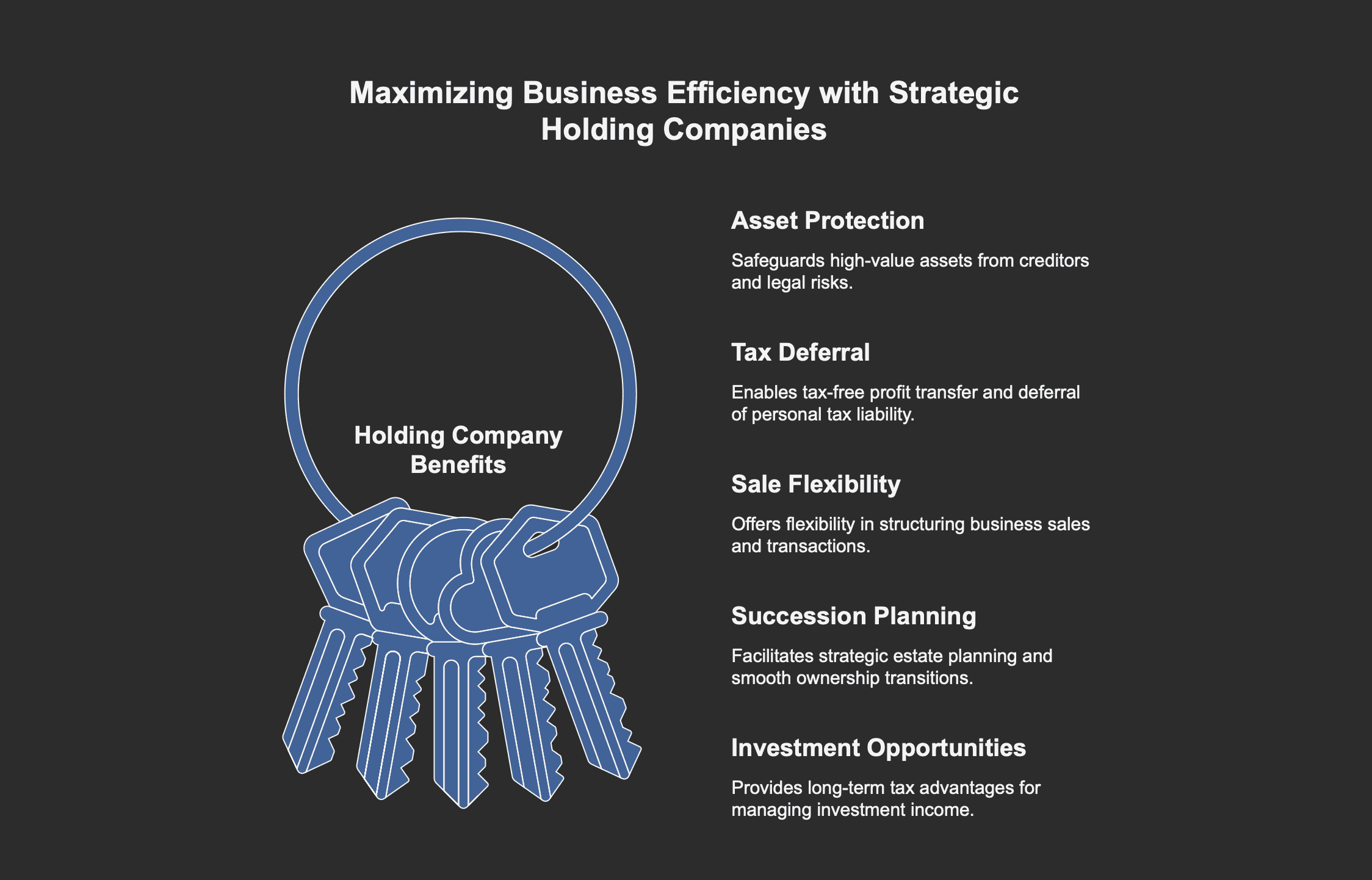
1. Asset Protection & Risk Management
By keeping high-value assets—such as real estate, intellectual property, or investments—within the holding company, these assets may be protected from creditors and legal risks tied to the operating business. If the operating company faces financial difficulties or lawsuits, assets in the holding company might not be directly impacted, offering an extra layer of security.
2. Tax Deferral & Efficient Cash Flow Management
A holding company allows the operating company to transfer excess profits tax-free through inter-corporate dividends. Instead of withdrawing profits as personal income (and paying immediate taxes), funds can remain within the corporate structure, deferring personal tax liability and enabling strategic reinvestment.
3. Business Sale Flexibility
Holding companies provide greater flexibility in structuring a business sale. A buyer may be interested in purchasing the operations but not necessarily the real estate, land, or other investments held within the business. By separating these assets in a holding company, a business owner can sell the operating company while retaining valuable assets.
Alternatively, if a buyer wants to purchase both the operating company and the real estate, the holding company allows for a separate transaction for the property, giving both parties flexibility in structuring the deal. This can provide tax benefits and allow for smoother financing arrangements.
4. Estate & Succession Planning
A holding company allows for strategic estate freezes, which lock in the current value of a business while allowing future growth to accrue to new shareholders, such as family members or key employees. This helps reduce future tax liabilities and makes transitioning ownership smoother.
Additionally, new shareholders can be added to the operating company without necessarily becoming owners of investment properties, land, or other non-operating assets held in the holding company.
5. Investment & Income Splitting Opportunities
A holding company can be used to hold investments, including stock portfolios, rental properties, and other financial assets. While income splitting is restricted under the Tax on Split Income (TOSI) rules, a properly structured holding company can still provide long-term tax advantages when managing investment income.
The Capital Gains Exemption & Holding Companies
One of the most attractive tax benefits for business owners is the Lifetime Capital Gains Exemption (LCGE), which shields up to $1,250,000 (2025 limit, indexed annually) of capital gains from tax when selling shares of a Qualified Small Business Corporation (QSBC).
However, qualifying for the LCGE when using a holding company is complex. If the holding company owns shares in the operating company, the business group must be properly structured—often involving the use of a trust—to ensure that the LCGE can still be claimed in the future. Poor structuring can inadvertently disqualify business owners from this tax benefit.
When Should You Consider a Holding Company?
A holding company may be beneficial if:
• You own multiple assets and want to protect them from business risks
• Your operating company generates excess profits and you want to defer personal tax
• You plan to sell your business in the future and need a tax-efficient structure
• You own multiple businesses and need an efficient way to manage them
• You need greater flexibility in bringing in new shareholders without giving them access to all assets
• You want to separate real estate or investments from daily operations
Challenges & Considerations
While a holding company provides many benefits, there are some downsides to consider:
• Complex Tax Rules – Ensuring compliance with LCGE qualifications, passive investment tax rules, and inter-corporate dividend tax strategies requires careful planning.
• Higher Corporate Tax on Passive Income – Investment income within a holding company is taxed at a higher rate than active business income.
• Added Costs – Incorporation, legal, and accounting fees must be considered.
Final Thoughts
A holding company is more than just a way to own shares in an operating company—it provides asset protection, tax deferral, estate planning flexibility, and business sale advantages. However, proper structuring is critical to ensure compliance with tax laws and maximize its benefits.
Thinking about setting up a holding company? The tax experts at ModernAxis can help you structure your business the right way. Contact us today for personalized advice!
Disclaimer: This blog post is for informational purposes only and does not constitute professional tax advice.
Frequently asked questions
When does it actually make sense to set up a holding company?
Usually when your operating company consistently generates more cash than you need to take home personally, when you want to protect accumulated retained earnings from operating liability, or when you are preparing for an eventual share sale and want to use the Lifetime Capital Gains Exemption. For most Canadian owner-managers that means $50,000 or more of annual excess cash flow before a Holdco pays off.
Do holding companies actually save tax?
Not on operating income — Canada's integration system means total tax on a dollar earned in Opco and paid out through Holdco roughly equals tax on that dollar earned personally. The benefit is deferral: excess profits stay invested inside Holdco at corporate rates until needed personally. The real savings come from passive-income placement, asset protection, and access to the LCGE on a future share sale.
How does the section 112 deduction work for intercorporate dividends?
ITA section 112 lets a Canadian corporation deduct dividends received from another taxable Canadian corporation, making the dividend effectively tax-free when it moves between connected corporations. This is the mechanism that lets profits flow from Opco up to Holdco without triggering tax. Anti-avoidance rules under section 55(2) can recharacterize the dividend as a capital gain if used to strip safe income artificially.
Can a holding company qualify for the Lifetime Capital Gains Exemption?
The LCGE applies to qualified small business corporation (QSBC) shares under ITA section 110.6, and a pure holding company on its own does not qualify because it doesn't carry on an active business. However, when Opco shares are held through a Holdco, careful purification planning (24-month asset test, 90-percent active business asset test at sale) lets the owner crystallize the exemption on the Opco shares while preserving the Holdco structure.
What is the cost to set up and maintain a holding company?
Legal setup typically runs $1,500 to $3,000 for incorporation, shareholder agreement, and section 85 rollover documents if applicable. Annual costs include corporate tax return preparation ($1,500 to $3,500 depending on complexity), CRA T2 filing, GST/HST registration if applicable, and provincial annual returns. Most owner-managers should expect $3,000 to $6,000 per year in total Holdco compliance costs.
Will a holding company protect my personal assets from a business lawsuit?
A Holdco protects assets it owns from claims against the Opco, but not the reverse. If Opco is sued, creditors can only reach Opco's assets, not Holdco's investment portfolio or real estate (assuming the corporate veil holds). The structure does not protect any director personally from director liability under sections 227.1 (CRA source deductions) or fiduciary duty claims, which is why personal director insurance still matters.
Alex Ataman, CPA
Founder
Modern Axis CPA