Estate Freeze for Canadian Business Owners (2026)

The estate freeze is one of the most consequential structural decisions an incorporated Canadian business owner ever makes. It caps the owner's exposure to future tax on growth — the company's current value becomes the maximum amount taxed in the owner's hands — and transfers all subsequent growth to the next generation (typically children, grandchildren, or a family trust). When combined with a family trust, an estate freeze multiplies the LCGE shelter across multiple Canadian-resident beneficiaries and provides meaningful asset protection.
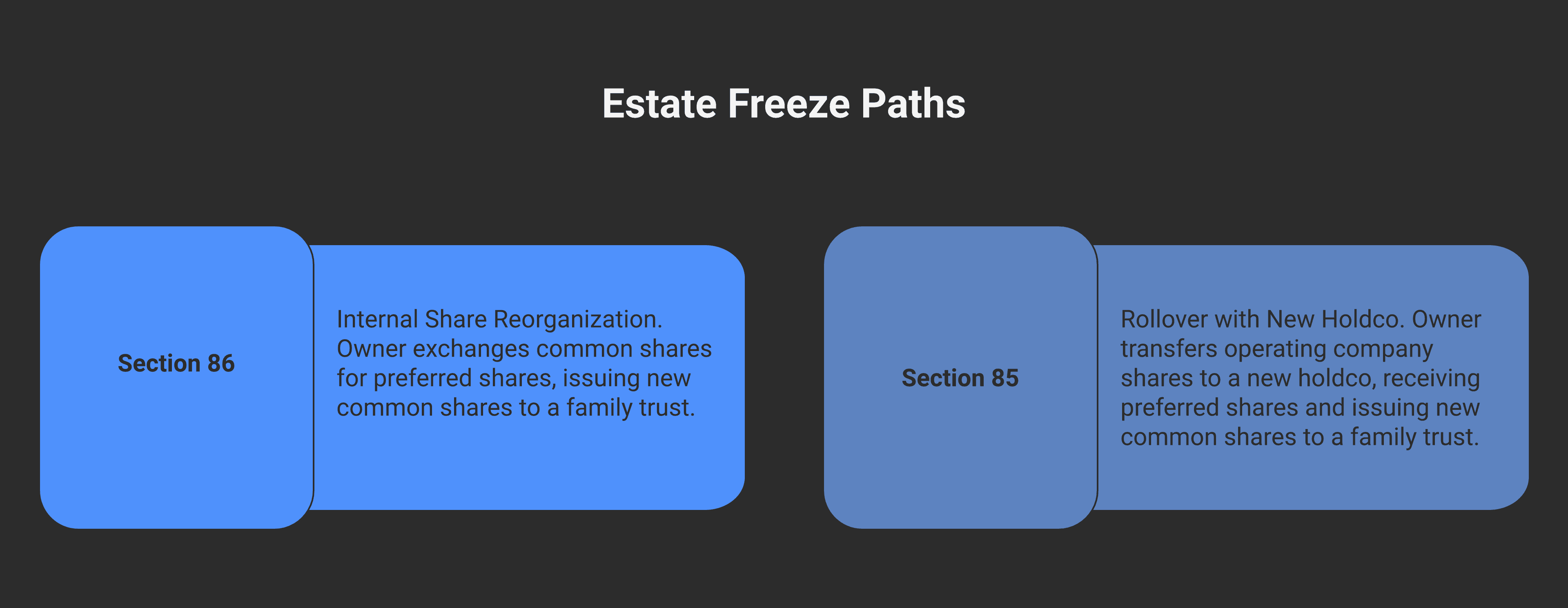
There are two main statutory tools: the section 86 internal share reorganization and the section 85 rollover with new corporation. Each achieves the same fundamental result — the owner's value-capped preferred shares, growth shares to the next generation or trust — but with different mechanics and timing implications.
This guide walks through what an estate freeze actually does, the two main statutory paths, the price-adjustment clause that protects against valuation challenges, the asset-protection benefit, the LCGE multiplication via family trust, when not to freeze, and refreeze mechanics.
Key takeaways
An estate freeze caps the owner's value at FMV at the freeze date by converting growth shares into fixed-value preferred shares. Future growth accrues to common shares held by the next generation or a family trust — moving the future capital gain (and future tax) to those new holders.
Two main paths: Section 86 internal share reorganization (existing corporation, owner converts common shares to preferred; new common shares issued to family trust/children) and Section 85 rollover with new corporation (owner rolls company shares into a new holdco via s.85; new common in the holdco issued to family trust/children).
A Price Adjustment Clause (PAC) in the freeze documents protects against CRA valuation challenges — if CRA reassesses the FMV at the freeze date, the PAC automatically adjusts the preferred share value to the reassessed FMV, preventing a deemed dividend or punitive tax.
A family trust is typically used as the holder of the new common shares. The trust's beneficiaries (owner's spouse, adult children, grandchildren, certain other family members) collectively share the future growth. Combined with the $1,275,000 LCGE in 2026, the trust can multiply LCGE shelter across multiple beneficiaries on a future sale.
When NOT to freeze: when the business has likely peaked in value (a freeze locks in the peak; future declines stay in the owner's hands), when the owner needs future growth in their own retirement portfolio, or when there's no near-term plan to involve next-generation owners.
What an estate freeze actually does
An estate freeze is a corporate restructuring transaction that:
Crystallizes the owner's current value. The owner's economic interest in the corporation is converted into a fixed-value instrument — typically preferred shares with a redemption value equal to the corporation's FMV at the freeze date.
Allocates future growth elsewhere. New common shares (or a similar growth instrument) are issued to a family trust, to children directly, or to another planned next-generation holder. These new shares hold all the future growth.
Preserves the owner's ability to extract current value. The preferred shares typically pay dividends (or can be redeemed at the freeze-date value) — giving the owner continued income from the business.
The structural effect: the deemed disposition on the owner's eventual death (under subsection 70(5) of the Income Tax Act) is calculated against the frozen preferred share value, not against the much higher future FMV. All growth from the freeze date onward is captured by the new common shares — and is taxed in the hands of the next-generation holders, who typically have lower marginal rates and access to their own LCGE on QSBC shares.
Section 86 — internal share reorganization
The simpler path. The owner's existing common shares are exchanged for new preferred shares of the same corporation, with a redemption value equal to the corporation's FMV at the freeze date. The mechanism is section 86 of the Income Tax Act:
The mechanic:
Owner files articles of amendment to create new class of preferred shares
Owner exchanges existing common shares for new preferred shares
New common shares are issued to the family trust (or children directly)
Section 86 provides a rollover — the owner's exchange does not trigger a capital gain (the new preferred's ACB equals the old common's ACB)
Advantages:
Simpler structure — one corporation
No new corporation required
Often used when the operating company is also the planned holding entity
Disadvantages:
Cannot easily separate operating risk from frozen value (everything stays in one corp)
Can complicate financing (banks may have covenants on existing capital structure)
Section 85 — rollover with new corporation
The more flexible path. The owner uses a section 85 rollover to transfer their existing common shares into a newly-incorporated holding company. In exchange, the owner receives preferred shares of the new holdco (at frozen FMV) and the new common shares of the new holdco are issued to the family trust or children.
The mechanic:
Incorporate a new holdco
Owner transfers existing operating-co common shares to new holdco using section 85
Section 85 election allows the transfer to occur at a deemed proceeds equal to the owner's ACB (no immediate capital gain)
Owner receives preferred shares of new holdco (FMV = operating-co's frozen value) plus potential "boot" (cash or non-share consideration up to the ACB of the transferred shares)
New common shares of holdco are issued to the family trust or children
Operating co is now wholly-owned by the new holdco; the freeze applies to the holdco's shares
Advantages:
Creates a holdco structure that separates operating risk from owner's frozen value
Can be combined with holdco strategies for asset protection
Allows section 85 election flexibility (elect at ACB, or elect at any value up to FMV for capital gains planning)
Often the right choice when the operating co has substantial passive assets that need separation
Disadvantages:
More complex — two corporations
Higher legal and accounting costs
Requires updated banking arrangements
For most freezes, the choice between section 86 and section 85 turns on whether the owner wants to add a holdco to the structure or work within the existing operating corporation.
The Price Adjustment Clause (PAC)
A Price Adjustment Clause is included in the freeze documents to handle CRA valuation challenges. The PAC says: if CRA later determines that the FMV at the freeze date was different from the freeze value used, the preferred share redemption value automatically adjusts to the reassessed FMV.
Why it matters: Without a PAC, if CRA reassesses the FMV upward (e.g., says the freeze value of $5M was actually $6M at the freeze date), the freeze could trigger a deemed dividend to the owner under section 84(3) or a deemed gift to the next generation under section 69(1) — potentially worth hundreds of thousands of dollars in unintended tax.
With a properly-drafted PAC, CRA's reassessed valuation is automatically applied to the preferred shares without triggering the secondary tax events. The PAC is the cheapest insurance available in a freeze and should always be present.
Drafting requirements (per Guilder News Co. (1963) Ltd. v. MNR, the case relied on in CRA Income Tax Folio S4-F3-C1, and other CRA technical interpretations):
The PAC must be in writing, in the corporate documents
It must be unambiguous and self-executing
It must apply equally to upward and downward valuation adjustments
The adjustment mechanism must be definite (not discretionary)
CRA accepts the PAC mechanic where these conditions are met. Modern freeze documents universally include a PAC.
The family trust — multiplying the LCGE
The most common structure: the new common shares are issued to a discretionary family trust rather than directly to the children. The trust's beneficiaries are typically:
The owner's spouse
The owner's adult children
The owner's grandchildren (if any)
A small number of additional family members (siblings, parents, etc.)
Why the family trust:
LCGE multiplication on a future QSBC sale. Each Canadian-resident beneficiary can use their own $1,275,000 LCGE on their allocated portion of the gain. A trust with five Canadian-resident beneficiaries can theoretically shelter 5 × $1,275,000 = $6,375,000 of capital gains on the eventual share sale (subject to TOSI analysis).
Asset protection. Trust assets are generally protected from beneficiary's creditors (subject to bankruptcy reach-back rules and similar exceptions).
Control flexibility. The owner can typically be a trustee, retaining significant influence over the trust's distributions and decisions.
Discretionary distribution. The trustee decides which beneficiaries receive distributions — letting the family adapt to changing circumstances over time.
We cover the family trust mechanics in detail including TOSI excluded-share planning, 21-year deemed disposition, and trust administration.
Asset protection
The structural separation between the owner's preferred shares (value frozen, redeemable on demand) and the next-generation common shares (held by the family trust) creates meaningful asset protection. Examples:
Owner's personal creditors (in a personal bankruptcy or judgment) can only reach the owner's preferred shares — value capped at FMV at freeze date. They cannot reach the future growth that's in the family trust's hands.
Spouse on marriage breakdown (if the owner divorces post-freeze) generally cannot reach the future growth in the family trust — it's not the owner's property.
Litigation against the owner personally — the owner's exposure is the frozen preferred share value, not the full corporate value.
The protection is meaningful but not absolute. Court-ordered claims, fraudulent transfer challenges, and certain regulatory matters can pierce the structure. Always structure with intent to protect future growth, not to defeat existing creditors.
When NOT to freeze
An estate freeze is not always the right answer. Consider not freezing when:
1. The business has likely peaked. A freeze locks in the peak value. If the corporation's value subsequently declines, the owner's preferred shares are stuck at the higher freeze value (deemed dispositions at death are calculated against that higher value). For aging businesses past their growth phase, the freeze can lock in a higher tax bill.
2. The owner needs future growth in their own retirement. Freezing means the owner's portfolio is capped at the freeze value plus any retained earnings post-freeze. If the corporation's investment portfolio is the owner's primary retirement asset, freezing the entire structure may leave inadequate retirement assets.
3. There's no near-term plan to involve the next generation. A freeze without a trust beneficiary structure that actually involves the next generation can create awkward family-control dynamics. The new common shares technically belong to the trust beneficiaries — if they're not engaged or aren't appropriate, the freeze creates more issues than it solves.
4. The corporation is owned by multiple unrelated parties. Each owner faces different freeze decisions — coordinating freezes across multiple unrelated owners often makes the structure more complicated than the tax savings justify.
5. The owner is single, no children, no intended next generation. Without the family-trust beneficiary structure, the freeze typically delivers limited benefits relative to its cost.
For most owner-managers with operating businesses growing in value, a child or two who'll continue the business, and a 5-10 year horizon to exit — the freeze is a fairly obvious win. The cost-benefit shifts when these conditions don't hold.
Refreezing
If a freeze was done early and the corporation has grown substantially since — and the next generation hasn't entered the business in the way originally anticipated — the original freeze can be refrozen.
A refreeze involves:
The owner exchanges their existing frozen preferred shares for new preferred shares at the current (higher) corporate FMV
The new common shares now hold only the future growth from the refreeze date forward
The intermediate growth (between the original freeze and the refreeze) is captured by the original common shares — which may have been issued to a now-grown family trust or to children who are no longer the right holders
Refreeze decisions are common for businesses that grew rapidly in the post-freeze period. The mechanics are similar to the original freeze, with section 86 or section 85 used to execute the share exchange.
Timing and cost
A typical estate freeze involves:
Tax planning conversation: 2-4 hours with CPA + tax lawyer
Valuation: Independent business valuation (chartered business valuator) — $5K-$25K depending on size and complexity
Documents: Corporate amendments, share exchange documents, trust establishment if applicable — $10K-$30K legal fees
Filing: Section 85 election (T2057) or section 86 deemed mechanic, plus updated corporate filings
Ongoing: Annual T3 trust returns if trust is involved; updated corporate-side dividend pool tracking
For a typical $1M-$5M owner-managed business, all-in cost is in the $25K-$60K range. The tax savings on the eventual sale (LCGE multiplication, frozen-value at death, etc.) typically dwarf this cost — often by 10x or more.
For Modern Axis client engagements on estate freezes, the typical workflow is: initial consultation → valuation engagement → tax-lawyer engagement for corporate documents → trust deed (if applicable) → execution → annual maintenance. Owner-managers planning a freeze should begin the process 6-12 months before the planned freeze date to allow proper documentation and valuation.
Frequently asked questions
What is an estate freeze in Canada?
An estate freeze is a corporate restructuring transaction that caps the owner's economic interest in their corporation at the current fair market value (the freeze value), and transfers all future growth to the next generation — typically children, grandchildren, or a discretionary family trust. The owner exchanges their existing common shares for fixed-value preferred shares (the "frozen" interest); new common shares are issued to the next-generation holder. Future growth accrues entirely to the new common, reducing the owner's tax exposure on eventual death or sale.
What's the difference between a section 86 and section 85 estate freeze?
A section 86 freeze is an internal share reorganization within the existing corporation — the owner exchanges old common shares for new preferred shares of the same corporation. A section 85 freeze uses a newly-incorporated holding company — the owner rolls operating-co shares into the new holdco via a section 85 rollover, and the new common shares of the holdco are issued to the next-generation holder. Section 86 is simpler; section 85 provides more flexibility for asset protection, holdco structure, and separation of operating risk.
What is a Price Adjustment Clause and why do I need one?
A Price Adjustment Clause (PAC) is a contractual provision in estate freeze documents that automatically adjusts the preferred share redemption value if CRA reassesses the FMV at the freeze date. Without a PAC, an upward FMV reassessment could trigger a deemed dividend to the owner or a deemed gift to the next generation — potentially worth hundreds of thousands of dollars in unintended tax. The PAC must be in writing, unambiguous, self-executing, and apply equally upward and downward. CRA accepts the PAC mechanic where these conditions are met.
How does a family trust multiply the LCGE in an estate freeze?
A discretionary family trust holding the new common shares can allocate future capital gains (on a sale of those shares) to multiple Canadian-resident beneficiaries — typically the owner's spouse, adult children, grandchildren, and certain other family members. Each beneficiary uses their own $1,275,000 LCGE (2026) to shelter their allocated portion of the gain. A trust with five Canadian-resident beneficiaries can theoretically shelter 5 × $1,275,000 = $6,375,000 of capital gains on the eventual sale (subject to TOSI analysis under section 120.4).
When should I not do an estate freeze?
Consider not freezing when: (1) the business has likely peaked — the freeze locks in the peak value and future declines stay in the owner's hands; (2) the owner needs future growth in their own retirement portfolio; (3) there's no near-term plan to involve the next generation; (4) the corporation has multiple unrelated owners with different freeze decisions; (5) the owner is single with no intended next generation. For most owner-managers with a growing business and engaged next-generation candidates, the freeze is a clear win.
How much does an estate freeze cost?
A typical estate freeze for a $1M-$5M owner-managed business costs $25K-$60K all-in: $5K-$25K for the business valuation by a chartered business valuator, $10K-$30K in legal fees for corporate amendments and trust documents, plus ongoing T3 trust returns annually if a trust is involved. The tax savings on the eventual sale (LCGE multiplication, frozen-value at death, etc.) typically dwarf the cost — often by 10x or more.
Can I refreeze an estate that was frozen years ago?
Yes. A refreeze involves exchanging the owner's existing frozen preferred shares for new preferred shares at the current (higher) corporate FMV. The new common shares (issued in the refreeze) hold only future growth from the refreeze date forward. Refreezes are common when a business grew substantially since the original freeze and the next-generation holders or trust structure need to be reconsidered. The mechanics use section 86 or section 85 in the same way as the original freeze.
This article is for general information only and does not constitute professional tax, accounting, or legal advice. Every tax situation is different, and a blog post — no matter how detailed — cannot account for the specific facts that may change the analysis for you. Before acting on anything you've read here, speak with a qualified tax professional about your own circumstances.
Alex Ataman, CPA
Founder
Modern Axis CPA