Can You Claim a Non-Resident Spouse as a Dependant in Canada?
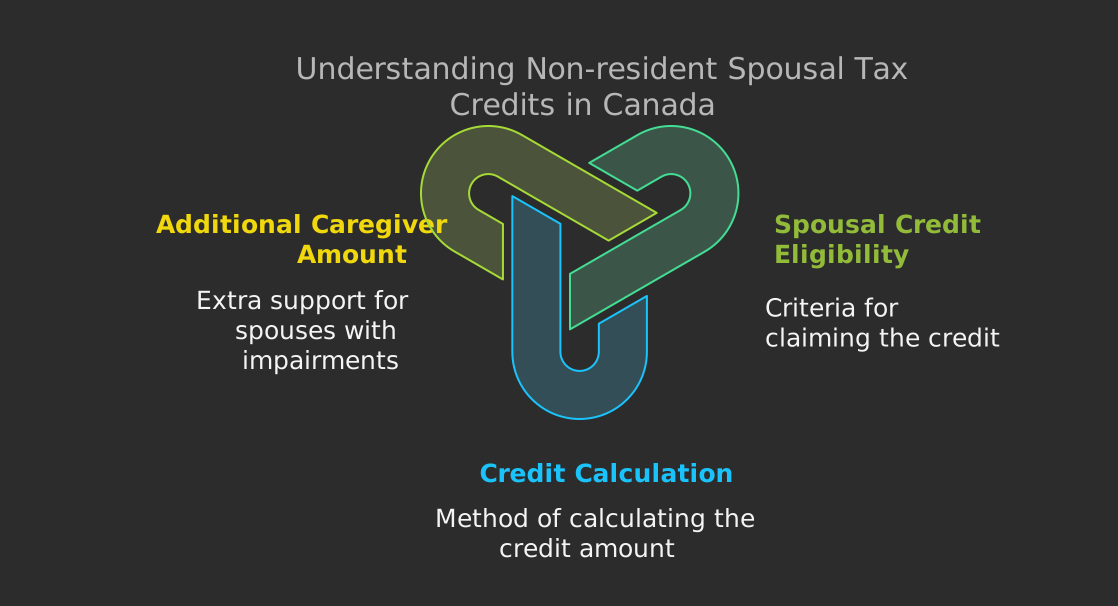
Filing taxes in Canada can be complicated, especially when it comes to understanding which tax credits apply to your situation. One common question for taxpayers with a spouse living outside the country is: Can I claim my non-resident spouse as a dependant?
Key takeaways
You can claim the spousal amount for a non-resident spouse only if you support them financially and the marriage is in good standing under CRA rules.
The spousal credit equals the basic personal amount (line 30300) minus your spouse's net income from all worldwide sources, reported in Canadian dollars.
Documentation matters more than residency status: CRA expects proof of marriage, proof of support, and a clear record of your spouse's worldwide income.
If your non-resident spouse has a mental or physical impairment, the Canada Caregiver Amount can stack on top of the basic spousal credit on line 30425.
In this guide, we’ll break down spousal tax credits, eligibility criteria, and how to maximize your tax benefits.
What Is a Spousal Tax Credit?
The spousal tax credit allows taxpayers to claim a non-resident spouse as a dependant if they provide financial support. The Canada Revenue Agency (CRA) recognizes this credit for individuals who are legally married or in a common-law relationship.
To qualify, your spouse must earn less than the basic personal amount listed on line 30000 of your tax return. The credit is calculated by subtracting your spouse’s net income (line 23600) from your personal credit. Additionally, if your spouse has a disability, you may qualify for the caregiver amount.
Who Can Claim the Spousal Amount?
You can claim the spousal amount if:
You are legally married or in a common-law relationship.
Your spouse's income is below the basic personal amount.
Your relationship remains in good standing (the CRA considers couples separated if they have lived apart for 90 days due to a breakdown in the relationship).
Your spouse lives separately from you for reasons beyond your control (e.g., work, education, or medical treatment).
Understanding tax terms is crucial when determining eligibility:
Resident: Residency is determined based on residential ties, not citizenship. This includes time spent in Canada and the intention to establish permanent residence.
Non-Resident: A non-resident stays in Canada for less than 183 days per year and has no significant residential ties.
Dependant: Someone financially reliant on you, including a spouse, child, or relative.
Residential Ties: Includes housing, vehicle registration, driver’s license, and family location.
Common Questions About Spousal Tax Credits for Non-Residents
How do I file taxes in Canada if my spouse lives in another country?
Before filing, determine your residency status. If eligible, file your return with Schedule 5 to claim a spousal or caregiver credit.
Can I file taxes jointly if my spouse is a non-resident?
No. In Canada, you must file individually but include details about your non-resident spouse to determine your tax credits.
Can I claim my non-resident spouse as a dependant?
Yes, if:
Your spouse earns less than the basic personal amount.
You are apart due to life circumstances, not marital breakdown.
Your spouse relies on you financially.
If your spouse is mentally or physically impaired, you may qualify for an additional caregiver credit.
What are the rules for claiming a dependant?
A dependant is anyone who relies on you for financial support, including a spouse, child, or certain relatives. They must have little to no income or be impaired.
Understanding spousal tax credits can help maximize your tax refund and reduce your taxable income. If you need guidance, ModernAxis is here to help you navigate complex tax scenarios with ease.
Disclaimer: This blog post is for informational purposes only and does not constitute professional tax advice. Always consult with a qualified tax accountant for personalized guidance.
Frequently asked questions
Can I claim my non-resident spouse as a dependant in Canada?
Yes, but only if you financially support them and they meet the income test. The spousal amount on line 30300 is available regardless of where your spouse lives, provided the marriage is in good standing. CRA accepts non-resident spouses, but they must convert their worldwide income to Canadian dollars and report it accurately. Without proof of support, the claim is often denied on review.
What income counts toward my spouse's net income for the spousal credit?
All worldwide income from every source — employment, business, investment, rental, pension, and government benefits — calculated as if your spouse had filed a Canadian return. Convert each amount to Canadian dollars using the Bank of Canada exchange rate. If their net income exceeds the basic personal amount (about $16,129 for 2025), no spousal credit is available. Even small foreign earnings can reduce or eliminate the credit.
Does my non-resident spouse need a SIN or ITN to claim the credit?
Yes. CRA requires either a Social Insurance Number or an Individual Tax Number (ITN) for your spouse on your return. Apply for an ITN using Form T1261 before filing. Without it, CRA will process the return without the spousal credit and you'll need to amend later. Allow 6 to 8 weeks for ITN processing; submit early if you plan to claim the credit.
What proof of marriage and support does CRA require?
A marriage certificate (with certified English or French translation if issued in another language) and documentation of financial support. Support evidence includes wire transfer receipts, bank statements showing regular remittances, or proof of paid expenses like housing or medical costs. CRA does not require a fixed support amount, but the support must be consistent and material relative to your spouse's needs.
Can I claim the Canada Caregiver Amount for an impaired non-resident spouse?
Yes, if your spouse has a mental or physical impairment that requires more care than typical for someone their age. Claim it on line 30425 in addition to the basic spousal amount. CRA may request a doctor's statement describing the impairment and its duration. The amount is reduced as your spouse's net income rises and phases out completely at a defined threshold, so model the credit before relying on it.
What if my spouse and I live apart for work or immigration reasons?
The spousal credit still applies if you live apart for reasons beyond your control — work, education, medical treatment, or pending immigration. The credit is denied only if you've separated due to a breakdown in the relationship and have lived apart for 90 days or more. Keep documentation of the reason for the separation, including immigration paperwork or employment records, in case CRA reviews the claim.
Alex Ataman, CPA
Founder
Modern Axis CPA