BC Speculation and Vacancy Tax: 2026 Guide
The BC Speculation and Vacancy Tax (SVT) is an annual provincial tax on residential property in specified BC regions — and it has changed materially for 2026. The rates are doubling: Canadian citizens and permanent residents with vacant or underused homes now pay 1% of assessed value (up from 0.5%); foreign owners and satellite families pay 3% (up from 2%). At the same time, the non-refundable tax credit available against the SVT for residents in the specified regions has doubled to $4,000 (up from $2,000).
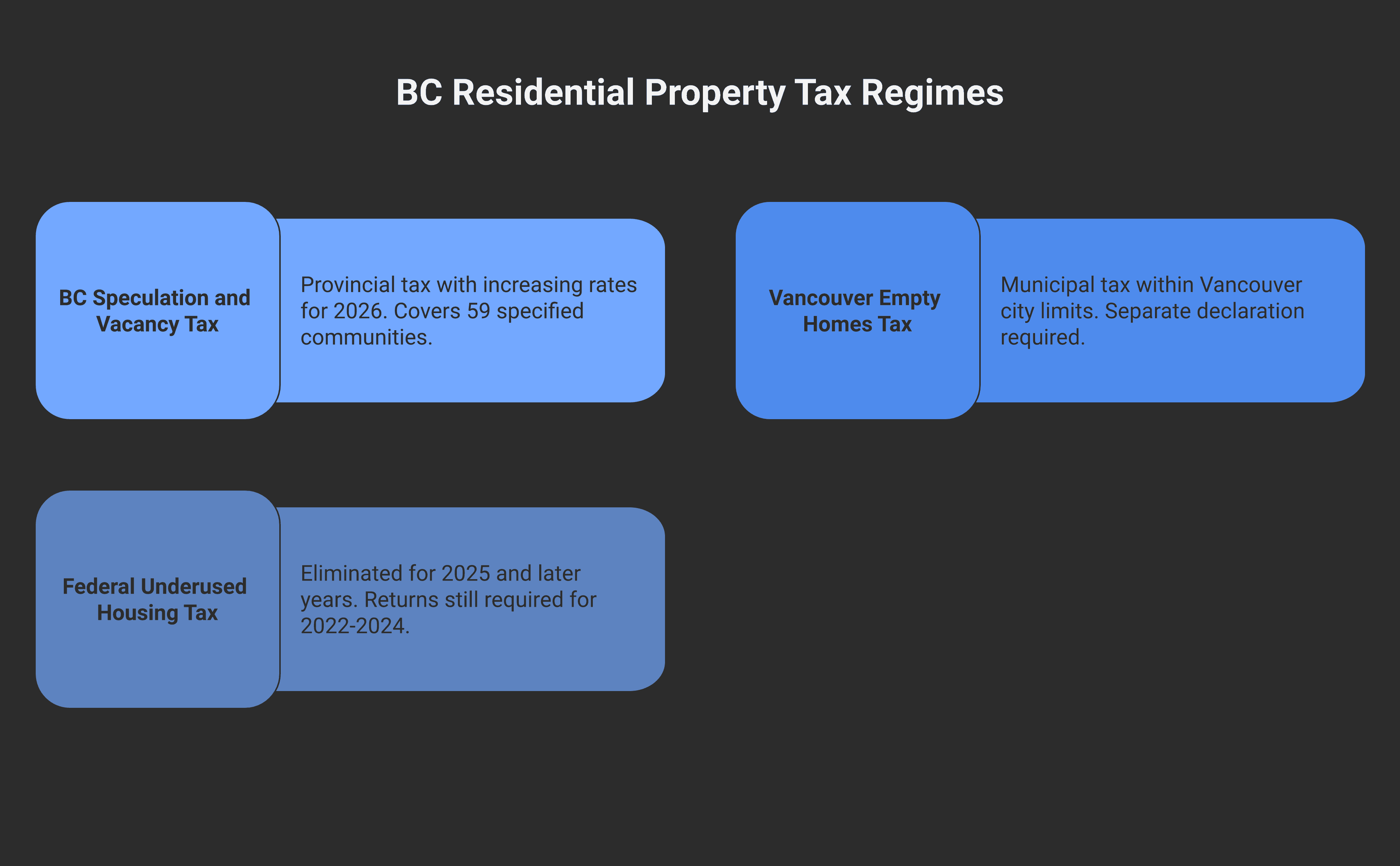
The other big 2026 development is the elimination of the federal Underused Housing Tax (UHT) — Budget 2025 cancelled the federal annual 1% tax on vacant foreign-owned property effective for the 2025 calendar year onward. Most BC residential property owners now face three potential annual vacancy regimes — the BC SVT, the Vancouver Empty Homes Tax, and (for 2022-2024 still) the now-defunct federal UHT.
This guide walks through how the BC SVT actually works in 2026 — the new rates, the 59 specified taxable communities, the mandatory annual declaration, the exemptions, and the practical interaction with the federal UHT's elimination.
Key takeaways
For the 2026 tax year (declared in 2027), the BC Speculation and Vacancy Tax rate is 1% of assessed value for Canadian citizens and permanent residents with vacant/underused homes in specified regions — doubled from 0.5%. Foreign owners and "satellite families" (those with most income earned outside Canada) pay 3% — up from 2%.
The tax applies in 59 specified taxable communities across five regional districts. Every residential property owner in those communities — including exempt owners — must file an annual declaration by March 31 of the year following.
The non-refundable tax credit for BC resident filers in the specified regions is $4,000 for 2026 (doubled from $2,000). Available against the SVT only — does not transfer to other taxes.
The federal Underused Housing Tax (UHT) has been eliminated — Budget 2025 cancelled the federal 1% annual tax on vacant foreign-owned property effective for the 2025 calendar year onward. Returns and tax for 2022-2024 still apply.
Common exemptions: principal residence; tenanted residential property (rented at least 6 months of the year, with a non-related tenant for arm's-length rents); life events (death of owner, new owners' property under renovation, separation, etc.); seasonal rentals where the property is rented to qualifying tenants for the required period.
What is the BC Speculation and Vacancy Tax?
The BC Speculation and Vacancy Tax was introduced by the BC NDP government in 2018 as an annual provincial tax on residential property held in specified regions. It is governed by the BC Speculation and Vacancy Tax Act.
The tax applies to:
Residential property classified as Class 1 (residential) under the BC Assessment Act
Located in one of 59 specified taxable communities
Owned, at year-end (December 31), by an individual or entity that does not qualify for an exemption
Critically, every owner in a specified region must file an annual declaration — even if they qualify for an exemption. Missing the declaration deadline (March 31 of the following year) results in the maximum tax being applied as the default, plus penalties. The declaration is the only way to claim an exemption.
The 2026 rate changes
The BC government announced in 2025 that SVT rates would increase effective for the 2026 tax year:
Owner type | 2025 rate (declared 2026) | 2026 rate (declared 2027) |
|---|---|---|
Canadian citizens and permanent residents | 0.5% | 1.0% |
Foreign owners | 2.0% | 3.0% |
Satellite families | 2.0% | 3.0% |
The change effectively doubles the tax burden for affected owners. The increase was announced explicitly as a counter to the federal UHT's elimination — the BC government's view was that the federal tax was inefficient but the housing-policy goal of discouraging speculation remained.
Satellite family definition under the BC Speculation and Vacancy Tax Act: a household where the majority of total worldwide income is unreported as income on Canadian tax returns. The classic case is a household with two spouses where one earns substantial foreign income (often based abroad) and the Canadian-resident spouse earns less or no Canadian income — even where one or both spouses are Canadian citizens or PRs.
The 59 specified taxable communities
The tax applies in:
Metro Vancouver Regional District: Vancouver, Burnaby, Richmond, Surrey, Coquitlam, North Vancouver, West Vancouver, Delta, New Westminster, Port Coquitlam, Maple Ridge, Pitt Meadows, Port Moody, Langley (city + township), White Rock, Anmore, Belcarra, Bowen Island, Lions Bay (some areas excluded — verify by address).
Capital Regional District: Victoria, Saanich, Oak Bay, Esquimalt, Colwood, Langford, Sidney, View Royal, Central Saanich, North Saanich, Highlands, Metchosin, Sooke (some Salt Spring and Southern Gulf Islands areas excluded).
Fraser Valley Regional District: Abbotsford, Chilliwack, Mission. (Some Fraser Valley municipalities excluded — verify.)
Capital, Nanaimo, Central Okanagan, Fraser Valley specific cities are within scope. Other Vancouver Island and Interior communities are not.
Newer additions (2022-2024): Lions Bay, Squamish (added 2023), Lake Country, West Kelowna (added 2024).
The full current list is on the BC Ministry of Finance website and changes periodically. For a property in a borderline area, always confirm with the SVT specified-region lookup.
The mandatory annual declaration
Every owner of residential property in a specified region must file an SVT declaration by March 31 of the year following. For the 2026 tax year, that's March 31, 2027.
The declaration is submitted via the BC government's online portal or by phone. The owner reports:
Whether they used the property as their principal residence
Whether the property was tenanted (and for how long, to whom, at what rent)
Any life-event exemption claimed
Any other applicable exemption
Filing the declaration is mandatory whether or not tax is owing. Owners who do not declare are assessed at the maximum rate (3% for foreign / satellite families, 1% for Canadian) on the full assessed value, plus a 10% late-payment penalty and interest on any unpaid balance after the due date. There is no flat-dollar SVT late-filing penalty. Most missed-declaration cases are corrected via a late declaration with reasonable explanation, but the friction is real.
Common exemptions
Principal residence. The most common exemption — the property is the owner's primary residence as of December 31 of the year. The owner does not need to be a Canadian citizen or PR to claim this (but foreign owners using a property as principal residence have other regimes to navigate, including the federal Prohibition Act and the BC ABTT).
Tenanted property. The property is rented to a long-term tenant (defined as occupied for at least 6 months of the year by a non-related tenant under a written agreement, at fair-market rent). Short-term rental (Airbnb-style) does NOT qualify. Tenancies that are too short or to family members at below-market rents do not qualify.
New owner exemption. Property acquired within the calendar year — owner has the year of acquisition to either move in (principal residence) or rent out (tenanted exemption) before the SVT applies. The exemption does not extend to subsequent years.
Life-event exemptions:
Owner's death — typically a one-year exemption for the estate
Owner spouse's death — extended exemption
Separation — typically two-year exemption following separation
New ownership (transfer) — one-year exemption
Owner medical care — exemption for owner in hospital or care facility
Owner's substantial renovation — exemption for the year during major renovation rendering property uninhabitable
Owner away for work or specialized education — exemption for owner in approved categories
Court order — property under court-ordered restriction
Special exemptions for development. Vacant land in the process of development, with permits and zoning in place, has its own exemption category.
Strata-titled hotel rooms that are subject to commercial use restrictions (not just held for owner's personal use) have specific exemptions.

The $4,000 non-refundable credit
For BC resident owners (Canadian residents who file a Canadian tax return and report income on it), the SVT comes with a non-refundable tax credit. For 2026, the credit is $4,000 (doubled from $2,000 for 2025 and earlier).
The credit:
Applies against the SVT owing
Is non-refundable (excess does not generate a refund)
Does not carry forward or transfer to other taxes
Is only available to BC resident filers; foreign owners and satellite families are not eligible
For most BC residents owning a single property in a specified region, the $4,000 credit often offsets the SVT in full. For example, a BC resident owning a vacant secondary property assessed at $400,000 in a specified region:
SVT at 1% = $4,000 owing
Credit = $4,000
Net SVT = $0
Above the threshold where credit fully offsets, the SVT applies on the excess. The credit doubling for 2026 mitigates the rate doubling for many BC-resident owners — but foreign owners and satellite families face the full 3%.
The end of the federal Underused Housing Tax
The federal UHT was a separate annual 1% tax on the value of vacant or underused residential property owned by certain non-Canadian, non-PR taxpayers and certain Canadian-owned entities (like certain Canadian-owned holding companies). It came into force for the 2022 calendar year.
Budget 2025, presented November 4, 2025, eliminated the UHT effective for the 2025 calendar year and onward:
No UHT payable for 2025 or later years
No UHT returns required to be filed for 2025 or later years
The UHT Act and Regulations will be formally repealed effective January 1, 2035 (the long timeline allows for prior-year compliance and audit follow-through)
The UHT for 2022-2024 still applies. Owners who had a UHT obligation for those years must still file (or correct prior filings) — penalties for 2022-2024 non-compliance continue. CRA's minimum late-filing penalty of $1,000 per affected property (for an individual) for 2022-2024 still bites.
The UHT's elimination is one reason the BC SVT rates rose for 2026 — the BC government wanted to ensure that policy pressure on speculative ownership continued at the provincial level even as the federal layer disappeared.
Common owner scenarios
Canadian resident with a vacant cottage in the Capital Region. The cottage is in a specified region, the owner is not occupying it as principal residence, and it's not tenanted for 6+ months at FMV. The SVT applies at 1% of assessed value. Annual declaration mandatory (March 31). The $4,000 non-refundable credit applies — covering tax on cottages up to $400,000 in assessed value. Above that, the owner pays the excess.
Foreign national with a Vancouver condo, used as a vacation home. Property in specified region (Metro Vancouver). Foreign-owner SVT rate of 3% applies. No principal-residence exemption. No tenant. The federal UHT used to add 1% — that's now gone. BC SVT at 3% × $1.5M assessed value = $45,000 annual cost. The 3% rate makes long-term ownership economically expensive without rental or principal-residence use.
Satellite family — Canadian-citizen spouse in Vancouver, foreign-earning spouse based abroad, household income majority foreign-sourced. The Canadian-owned property qualifies as satellite-family under the BC SVT definition. SVT at 3% applies. The owner's Canadian citizenship does not change the satellite-family treatment.
Long-term tenanted Vancouver triplex. Each unit tenanted to non-related tenants for 6+ months at FMV. The tenanted exemption applies to each unit. No SVT owing — but declaration still required for each unit.
Empty Vancouver condo, used 3 weeks per year personally. Personal use of less than 6 months and no rental does not qualify as principal residence (not used "primarily" as principal residence) and does not qualify as tenanted (not rented). SVT applies at 1% (Canadian) or 3% (foreign/satellite).
Vancouver-specific: The City of Vancouver's Empty Homes Tax (EHT) operates separately at 3% of assessed value for properties classified as vacant within Vancouver city limits. The EHT stacks on top of the SVT. So a vacant Vancouver condo owned by a Canadian resident in the SVT-specified region pays 1% SVT + 3% EHT = 4% combined, plus the $4,000 SVT credit.
Practical compliance
Declare even if exempt. The single most consequential compliance point: file the annual declaration by March 31 even when you qualify for an exemption. The exemption is only claimed via the declaration — defaulting to "I'm exempt, I don't need to file" is the most common error and triggers the maximum tax assessment.
Track tenancy carefully. The 6-month-tenanted exemption is fact-specific. The lease must be at fair-market rent, the tenant must be at arm's length, and the lease must cover at least 6 months of the calendar year. CRA-like audits of declarations focus heavily on these tenancy facts.
Coordinate with BC Foreign Buyer Tax and federal Prohibition Act. For foreign owners, the ABTT (one-time, 20% on purchase) and the SVT (annual, 3%) layer on top of the standard PTT and the federal Prohibition Act. The combined regime makes most non-Canadian residential ownership in major BC regions economically very expensive.
Watch the satellite-family test annually. A household whose income mix changes year-to-year may be Canadian-resident in one year and satellite-family the next. The annual declaration is where the determination is made.
For property in BC investor portfolios, structure for the tenanted exemption. Long-term tenancy at FMV is the cleanest path to SVT exemption for investment property. Short-term rental and family-occupied properties run into complications.
For Modern Axis clients with BC residential real estate, SVT declaration support is a standard part of annual filing season — coordinated with personal tax returns, capital gains planning on any planned sales, and the ABTT/Prohibition Act analysis on any acquisitions.
Frequently asked questions
What is the BC Speculation and Vacancy Tax rate for 2026?
For the 2026 tax year (declared in 2027), the BC SVT is 1% of assessed value for Canadian citizens and permanent residents with vacant or underused property in specified regions — doubled from 0.5% in 2025. Foreign owners and satellite families pay 3% — up from 2% in 2025. The non-refundable tax credit for BC residents was also doubled to $4,000.
What is a "satellite family" under the BC SVT?
A satellite family is a household where the majority of total worldwide income earned by the household is unreported on Canadian tax returns. The classic case is one spouse earning substantial foreign income (often based abroad) while the Canadian-resident spouse earns less or no Canadian income. Citizenship or PR status of one or both spouses does not change the satellite-family treatment — the determinative factor is where the household income is sourced and reported.
Which BC communities are subject to the SVT?
The SVT applies in 59 specified taxable communities across five regional districts: Metro Vancouver Regional District, Capital Regional District (Victoria area), Fraser Valley Regional District, Regional District of Central Okanagan (Kelowna), and Regional District of Nanaimo. The exact list has been expanded over time (Lions Bay, Squamish in 2023; Lake Country, West Kelowna in 2024) and a borderline-area property should be verified through the BC Ministry of Finance's specified-region lookup tool.
Do I have to file an SVT declaration even if I'm exempt?
Yes. Every owner of residential property in a specified region must file the annual declaration by March 31 of the year following — even when an exemption applies. Missing the declaration triggers the maximum tax assessment plus a 10% late-payment penalty and interest on the unpaid balance (there is no fixed $5,000/$25,000 SVT penalty). The exemption is only claimed via the declaration.
What is the difference between the BC SVT, the Vancouver Empty Homes Tax, and the federal UHT?
The BC SVT is a provincial annual tax in 59 specified BC communities at 1% (Canadian) or 3% (foreign/satellite) — declared by March 31. The Vancouver Empty Homes Tax is a municipal annual tax at 3% of assessed value applied within Vancouver city limits only — separate declaration. The federal Underused Housing Tax was a 1% federal annual tax on certain non-Canadian-owned vacant property — eliminated effective 2025 onward by Budget 2025. For 2022-2024, the UHT still applies and unfiled returns continue to carry penalties.
Is the federal Underused Housing Tax still in effect?
No, not for the 2025 calendar year onward. Budget 2025 (November 4, 2025) eliminated the UHT effective 2025. No UHT is payable and no UHT returns are required for 2025 or later years. However, all UHT requirements continue to apply for the 2022, 2023, and 2024 calendar years — unfiled returns and unpaid tax for those years still carry penalties. The UHT Act and Regulations are scheduled for formal repeal effective January 1, 2035.
Can short-term rentals (Airbnb-style) qualify for the SVT tenanted exemption?
Generally no. The SVT tenanted exemption requires the property to be rented to a non-related tenant for at least 6 months of the calendar year under a written agreement at fair-market rent. Short-term rentals — typical Airbnb, VRBO, or vacation rentals where the tenant changes weekly or more frequently — do not satisfy the 6-month continuous-tenant requirement. A property used principally for short-term rental and not as the owner's principal residence typically attracts the full SVT.
This article is for general information only and does not constitute professional tax, accounting, or legal advice. Every tax situation is different, and a blog post — no matter how detailed — cannot account for the specific facts that may change the analysis for you. Before acting on anything you've read here, speak with a qualified tax professional about your own circumstances.
Alex Ataman, CPA
Founder
Modern Axis CPA